
Reading time: 15 minutes
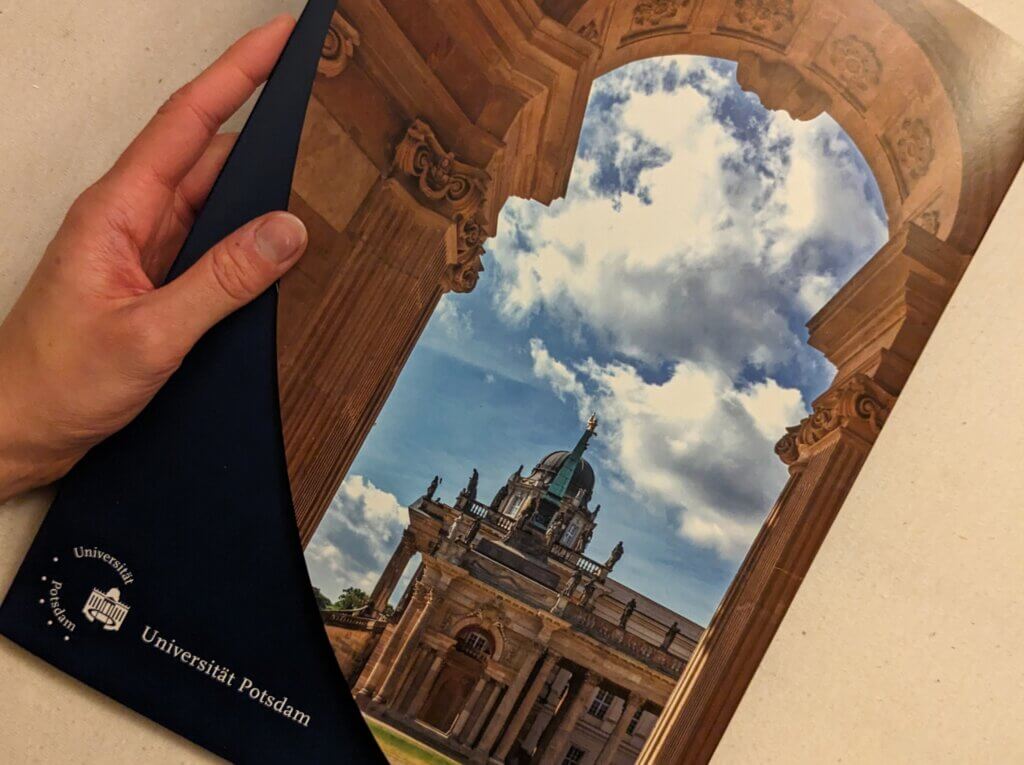
LIFE STORIES Four years have just flown by. Somehow, the end of my bachelor’s degree came much faster than I expected. In addition to my bachelor’s thesis, I have a number of decisions ahead of me that will have a significant impact on my future. Not only do I have to ask myself how I want to continue my studies, but also how and where I want to live in the future.
The first class at 7:20 a.m. has given way to a relaxed start to the university day at 10:15 a.m. The fear of surprise tests became a constant tension before the exam period. And the predetermined timetable became an organizational struggle due to all the deadlines in the university world. The transition from school to university was hard. But I mastered it and am now facing the next stage of my educational career: a master’s degree in physics.
The year 2025 is a year of decisions for me. Many personal changes await me. Which topic will I choose for my bachelor’s thesis? Which master’s program will I choose? Will I stay in Potsdam or will I move away? This article reports on the everyday life and challenges of the last months of my bachelor’s degree. And what I want to take with me for my master’s degree.
After two and a half months of work, I finally submitted my bachelor’s thesis. And I have to admit: I would have thought that finishing my bachelor’s degree would feel different. Four years of physics … I can hardly remember my everyday school life.
Celebrities in climate research
In January, writing my bachelor’s thesis was little more than a vision of the future. The seventh semester was in full swing and, as always, I was struggling to keep up with planning my exam preparation. I had gotten pretty good at juggling my free time and university, but it was still exhausting.
While writing my exams in early February, I noticed once again how different the requirements of the various modules were. The geophysics exam required memorized facts and the application of simple physical formulas. It reminded me of the physics exams I took in high school.
ThePhy II, on the other hand (you know, the one with the rolling cows), was a very difficult challenge for me, even with memorized solutions. As always, our professor had revealed the main topics of the exam in advance, so it wasn’t difficult to imagine the questions. I was lucky and was able to prepare myself ideally for two of the questions. I somehow struggled through the rest of the exam and came out with a satisfactory result. The more I have to do with it, the more I realize that theoretical physics is simply not my thing.
In contrast to ThePhy, climate physics continues to spark my interest. I was looking forward to the block seminar “Atmospheric chemistry of the ozone layer” that followed the semester with a professor who, a few years ago, had scientifically led the largest Arctic expedition in history. Every now and then, I thought about what it would be like to take part in an expedition myself. Maybe not in the Arctic, because I don’t like darkness and cold, but perhaps in the tropics. Although the climate there also has its pitfalls… but I’m starting to dream again.
First, I had to pass the climate physics module. The seminar took place on Telegrafenberg in Potsdam, the headquarters of the Helmholtz Centre for Polar and Marine Research. With temperatures as low as -12 °C, I cycled up the long hill to the science park every morning for a week. Our professor’s interest in the ozone layer was contagious. Full of enthusiasm, he gave lectures in English on chemical processes within the atmosphere and the human impact on the sensitive ozone layer that protects us from cosmic radiation. We also learned how to use the Fortran programming language, which is considered an important standard in climate physics.
After that, I had two weeks to memorize the contents of both the lecture “Climate History of the Earth” and the seminar “Atmospheric Chemistry of the Ozone Layer,” because I had a 30-minute oral exam waiting for me, which would conclude the climate physics module. Excited, I cycled up the beautiful Telegrafenberg for what would be the last time for the time being and had a “relaxed conversation” with two of the currently greatest climate scientists in Germany. I felt like I was sitting across from two celebrities. The fact that they were also testing my knowledge did not help my nervousness.
Despite my initial stammering, both professors were convinced of my knowledge and gave me a very good grade. I couldn’t answer the question of why I hadn’t already completed my bachelor’s thesis in the field of climate science. Somehow, I had never considered this possibility. Now, however, I was excited by the idea of focusing my master’s degree on climate physics. I felt comfortable with this subject area, which was both vivid and topical.
No longer a lone warrior
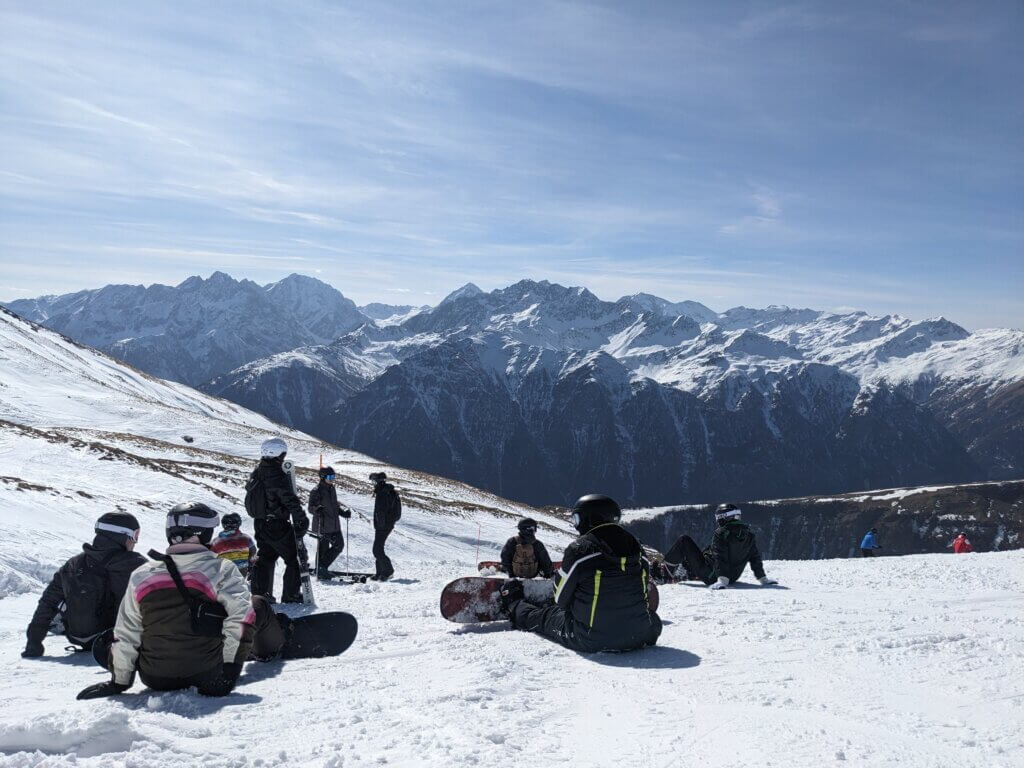
During my semester break, I had an unusual week of vacation ahead of me. Three friends and me, loaded with a snowboard and lots of winter clothes, drove my little Skoda Fabia to the Austrian Alps. At about 30 km/h, the car chugged slowly but surely up the mountains to an altitude of 1,300 meters. There, a large vacation home with a magnificent view of the valley awaited us. There were 19 of us in total, half of us experienced skiers and half of us complete beginners, who not only wanted to learn how to ski together, but also simply wanted to experience an intense time as a large group.
The vacation was definitely intense. Apart from headaches and bruises from snowboarding, every evening was an experience. It was like being in a completely different world. Not like in the Caribbean three years ago, where you were far away from everyone and everything. Rather, it was like being in the middle of a colorful crowd of many different young people, but still far away from everyday life.
Now, during the semester break, surrounded by this beautiful snowy landscape, I realized how little time I had spent with other students last semester. During school, you went through classes together with your classmates. But in advanced studies, when you chose a schedule that was separate from your fellow students, that was no longer the case and you became a lone warrior.
It was strange to be alone again after the vacation. I started working on my bachelor’s thesis right away because I wanted to finish as quickly as possible so that I could enjoy a few months off in the summer. Back at university, I was given an office space and a set of keys that gave me access to all the relevant laboratories. It was a strange feeling, because it made me feel as if I had been promoted from a normal student to a research assistant. Well, I wasn’t getting paid. But at least I was able to make a small contribution to current research through my bachelor’s thesis.
I was all the more nervous when I took my first measurement. My supervisor explained the flashing signal on the screen and what its change over time meant. When I think back to that moment now, I realize that I didn’t understand anything at the time. For about a month, I wrote the theoretical part of the thesis, struggled through English technical articles, and asked questions over and over again. It was fun to piece together all the bits of knowledge – facts and terms I had never heard of before – until I had a reasonably logical picture.
When I was done, there were still many details I didn’t fully understand. But I felt ready to start taking the right measurements. I also made many mistakes in the laboratory, so that countless results were unusable and had to be replaced with new ones. I was constantly learning.
Every Wednesday, I went to the university to exchange ideas with others and start new measurements. At 12:30 p.m., the entire research group team went to the cafeteria together, and I got to talk to a wide variety of people. Almost every time they talked about their research, I only understood half of what they said. But I belonged. Even though I was so inexperienced and asked someone else for help every time a new problem arose, they treated me like an equal physicist. I think that gave me my first impression of what it’s like to have good colleagues. Not stumbling through university courses alone, but doing research together.
In the world of research
I spent the rest of the week at home, working remotely. I set my own working hours and ended up working about six hours a day, five days a week, evaluating my measurements. There were frustrating days when I didn’t make any progress, while on others a flash of inspiration completely reshaped my understanding of physics and made the hours of work worthwhile.
Working with Python probably caused me the most headaches. I had never programmed before and only had a little insight into the languages C++ and Fortran. Now I had to use a new programming language to process hundreds of thousands of data points into diagrams and concrete numerical values. Together with my supervisor and ChatGPT, I somehow managed to gradually adapt programs for my data.
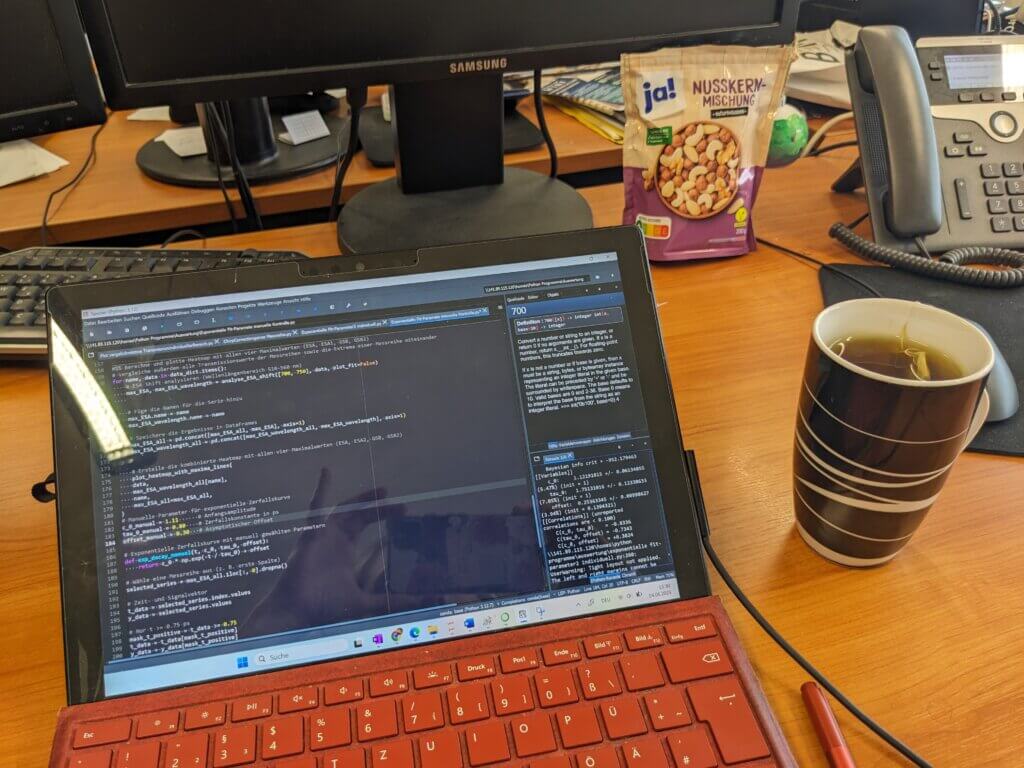
I quickly realized when the data reflected what was expected and when the data was so poor that it had to be repeated. It was a back-and-forth process of measurements, evaluations, and adjustments. The evaluation took shape only slowly. I often had to redo work because I noticed a small mistake or reached a dead end. Only gradually did my supervisor and professor give me fixed lines of research on which the evaluation of my data should be based.
It was June. Finally, the weather was taking on summery characteristics and I could see the end of my bachelor’s thesis approaching. My supervisor was satisfied with the measurement data, and I had used up almost all of the working hours allocated for the bachelor’s thesis in the study regulations. I declined my professor’s request to take more measurements for a paper. Although I enjoyed the research, this was still my bachelor’s thesis and not a paid scientific position.
After completing it, I had my mom and my boyfriend proofread my work. They were able to give me tips on format and expression. But the technical terms I used seemed so specialized that not even my boyfriend, who had studied physics himself, could fully understand them. It’s crazy how far removed the world of physics is from everyday life. It’s so complex that even physicists themselves can only comprehend a tiny fraction of it. And yet it’s incredibly fascinating. I finally submitted my bachelor’s thesis, which was 51 pages plus an appendix, to the examination board on June 24.
On July 2, I went to the university to make my data available to others for further research, return my keys, and, of course, thank all the group members for their support. My supervisor was surprised that I had submitted the thesis without letting him proofread it. Oops. Apparently, that was the norm in this department. I panicked briefly. What if I had made major mistakes in the thesis that my supervisor could have pointed out before grading it? But I calmed down relatively quickly. I was very confident in what I had produced.
At 12:30 p.m., I went to the cafeteria for lunch with my “colleagues” one last time. They were all amazed that I had actually finished so quickly. While I had been relaxing by the pool in 36 °C heat for a week, they had continued their exciting research day after day. Each and every one of them had contributed to a better understanding of our diverse world. An admirable job.
I had now completed all the courses and exams for my bachelor’s degree and could devote the next three months to enjoying the pleasures of summer. I had worked hard for this little break. I was now free, so to speak. Although… in addition to applying for my master’s degree, I still had a few personal tasks to take care of.
Life questions
Since starting my studies, I had been living in a student residence directly on campus. Although the rent here had also increased by 20 % of the initial price within three and a half years, it was still the cheapest accommodation in Potsdam. However, the time you could stay in the residence was limited to four years, so I slowly had to start looking for something new.
With the question of a possible move came the question of my further studies in January. I had since abandoned the idea of starting an internship (i.e., journalism training) after my bachelor’s degree. Although this would have been great for a career as a science journalist, the industry was overcrowded and very uncertain in terms of job prospects. With a master’s degree in physics, on the other hand, I would have a much broader range of possible careers and could still write. Researchers also reported on their new findings in specialist articles they wrote themselves. So, another two years of physics studies.
In Potsdam, I could choose between general physics, astrophysics, and the interdisciplinary program “Climate, Earth, Water, Sustainability (CLEWS).” Astrophysics and CLEWS are very specialized and primarily focused on data analysis and programming. Since I didn’t just want to work on a computer, but above all wanted to communicate research, I decided on general physics.
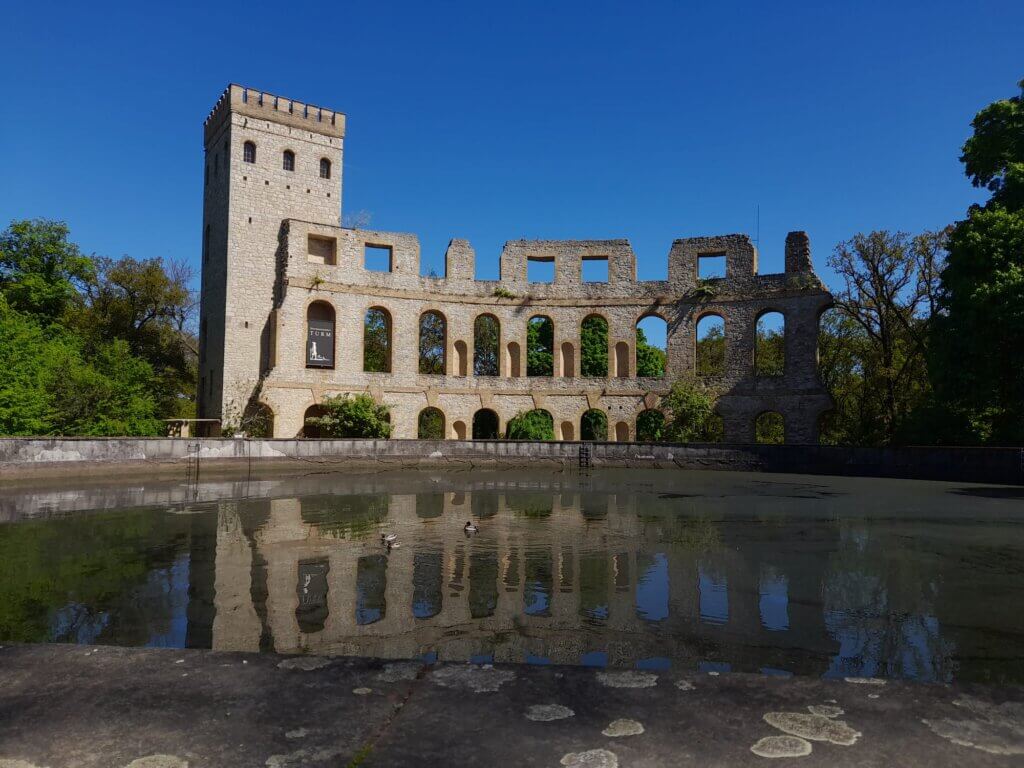
Of course, I didn’t have to stay in Potsdam. But because my boyfriend had to move to start his legal clerkship (to a city that is an hour’s train ride from Potsdam) and I neither wanted nor could afford an apartment in Potsdam on my own, it became clear to me relatively quickly that I would go with him. Did that mean I had to turn my back on Potsdam? I could also study in Berlin. There are two universities there that offer a master’s degree in physics.
But somehow I liked Potsdam. I liked the lecturers, the atmosphere, and the opportunities to specialize in climate physics. I thought about it for weeks. Commuting could be annoying with the reliability of Deutsche Bahn (the German railway company), but I think I was willing to put up with that if it meant I could live with my boyfriend and continue studying in Potsdam at the same time. Yes, I had made up my mind.
At the end of March, I gave up my place in the dorm and moved in with my boyfriend temporarily. I had expected it to be harder for me to turn my back on my very first apartment. But I was surprised. In fact, I was really excited to be able to design the next apartment completely freely. The only constraint was money.
At the time, I was living on student financial aid. Although I would be working as a proofreader in addition to my master’s degree, even that didn’t get me very far. Living space is scarce and rents are utopically high. I was far from the 1/3 of my total income that rent was supposed to take up. After estimating my monthly expenses, I could afford about € 500 per month for rent. So if my boyfriend and I wanted to share the rent equally, the maximum rent for our at least 60-square-meter apartment was € 1,000. A rather unrealistic idea, as we were to discover during the summer months.
Surfing into the future
How quickly can two months pass? With countless apartment viewings – there were so many that I eventually gave up counting – time just flew by. Who could have known that most apartments costing € 800 or € 900 looked as if they had last been renovated 30 years ago? On the other hand, many good apartments over 60 square meters now cost over € 1,200 in rent. That was a 25% price increase in this region over the last four years. The constant uncertainty was getting to us. Would we even find anything that reasonably met our expectations?
Midsummer (which had been rather cool this year) gave way to late summer when, at the end of August and after six months of intensive searching for a new home, we finally found a nice apartment in an old building that was only slightly above our budget. It was an incredible relief.
Because the apartment search was such a big issue this summer, it’s easy to forget everything else we got to experience. After learning to snowboard in March, we took up surfing in July. At a small surf camp in the Algarve in southern Portugal, I learned what it felt like to ride the waves. In the Harz low mountain range, I collected stamps with a small group of friends, which could be exchanged for hiking badges once you had collected a certain number. And in between all the annoying little errands and tasks – crafts for the apartment, my master’s application, annual planning, etc. – I tried to find a little peace and quiet.
Now, at the beginning of September, I look back on an intense summer full of experiences and ahead to two more years of studying the complex but wonderful world of physics. I hold my bachelor’s degree certificate in my hand. My bachelor’s thesis was graded 1.1, giving me an overall bachelor’s grade of 1.7. I am more than satisfied with myself and, as cliché as it may sound, I am looking forward to everything that lies ahead.
I know that the next few months may be challenging again: commuting to university, studying full-time, working a small part-time job, and still enjoying life. Growing up – which actually takes our whole lives – and finding our own path is not a straight line. Or to put it in mathematical terms: with strength and willpower, we fight our way up the rocky path to get closer and closer to the summit of happiness, even if we may never quite reach it.
It’s a bit like surfing. You learn and learn, and just when you think you can finally stand up and ride the wave, you fall into the water. You’re frustrated, but something inside you keeps you going. Despite your exhaustion, you keep paddling, because once you’ve fought your way back to the starting point through the many breaking waves, you can’t wait to try your luck again on the next good wave. And when you finally stand up, it’s an incredible feeling.
My studies at Potsdam University
Here you can find the other articles from my time at university in Potsdam:
- Live or study? – The highs and lows of my first exam phase (2022)
- University life – 2nd attempt, or: Trying to survive
- Semester 3 & 4 – Being on the same (Compton) Wavelength
- The normal madness and the joys of cycling – semesters 5 & 6
- Quantum, cows and paleoclimate – An update on my 7th semester
- Life Doesn’t Take a Semester Break – Navigating My 1st Master’s Semester
- Light quanta and sunburn – An introduction to quantum physics 2024
- Double Burden – Studying and working in Potsdam in 2022
- The World of the DPG 2021 – Physics, Journalism and Me