

Reading time: 18 minutes
LIFE STORIES My first master’s semester has a lot of surprises in store for me. So much is happening around me that I’m having a hard time focusing on my studies at all. Is it possible to be the star of a soap opera and understand relativistic quantum mechanics at the same time?
“I know that the coming period can be exhausting.” That’s more or less how my last article ended. I wish I hadn’t written that, because now, in mid-March of next year, I’ve had enough of all the stress. Instead of taking my final exam, I’m lying in the hospital staring at the ceiling. Plenty of time to reflect on the past six months.
Sleepless Nights and other difficulties
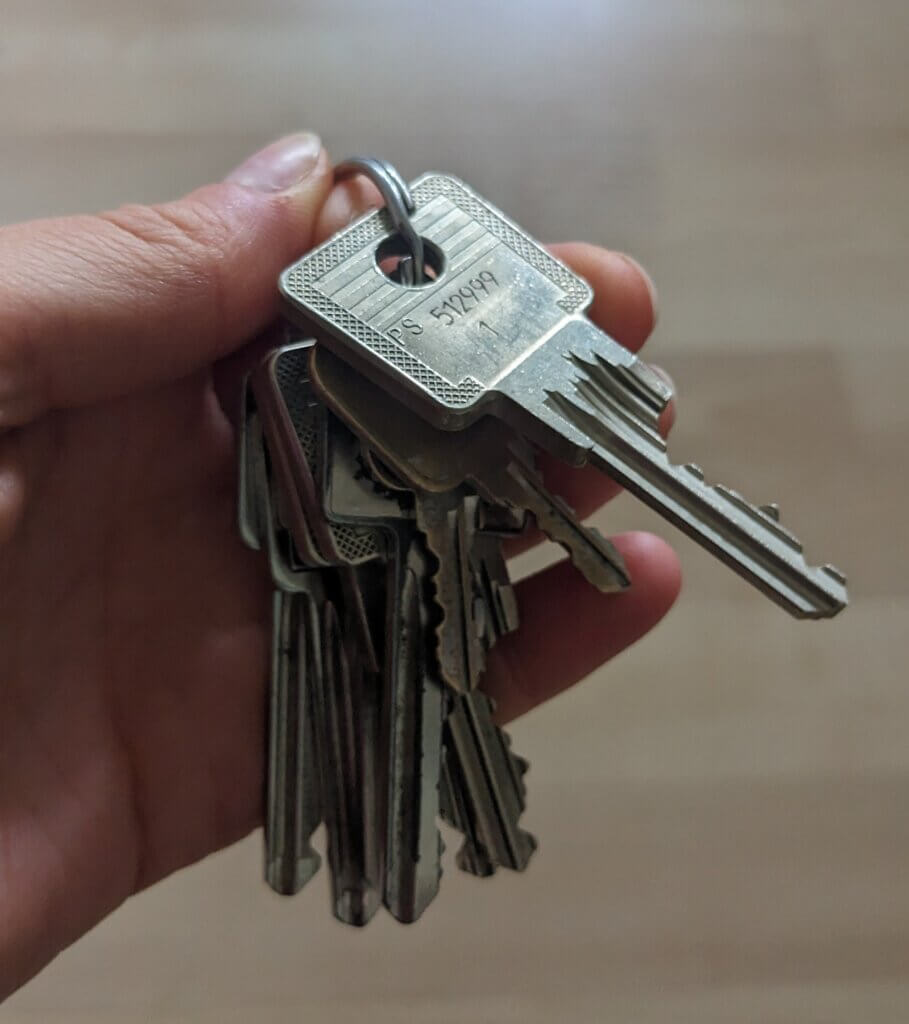
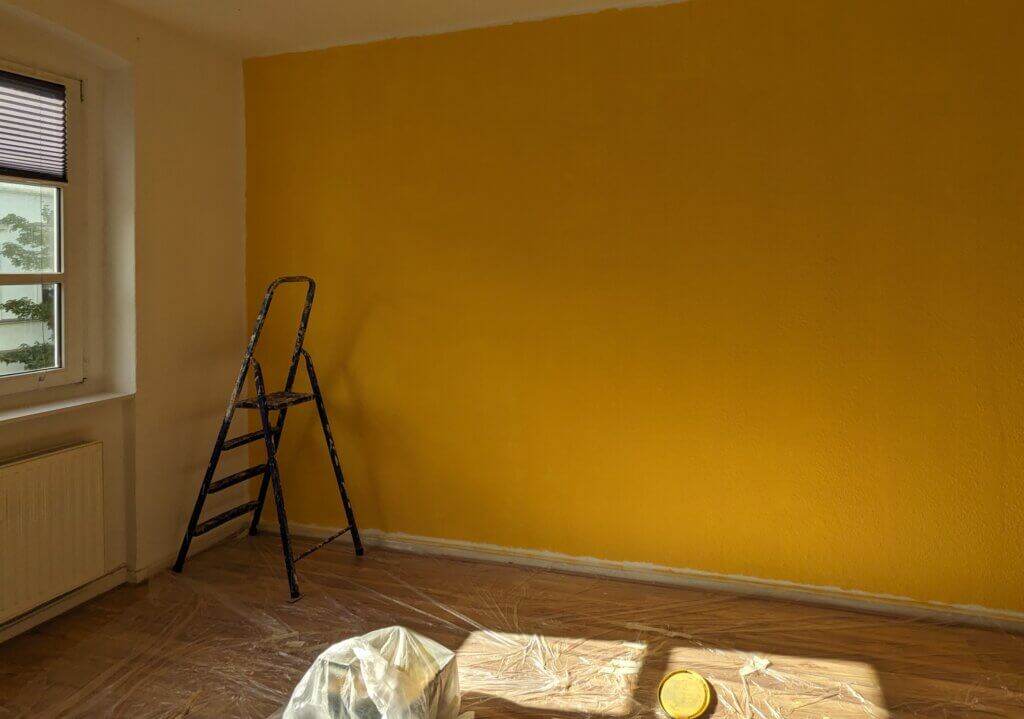
After we were handed the keys to our first apartment on August 30, 2025, my first two weeks of September just flew by amid the painting and furnishing. And then, just as we were finally ready to move in properly, my boyfriend got sick and was bedridden for two weeks. So, the move was put on hold. We didn’t finally move into our home until early October.
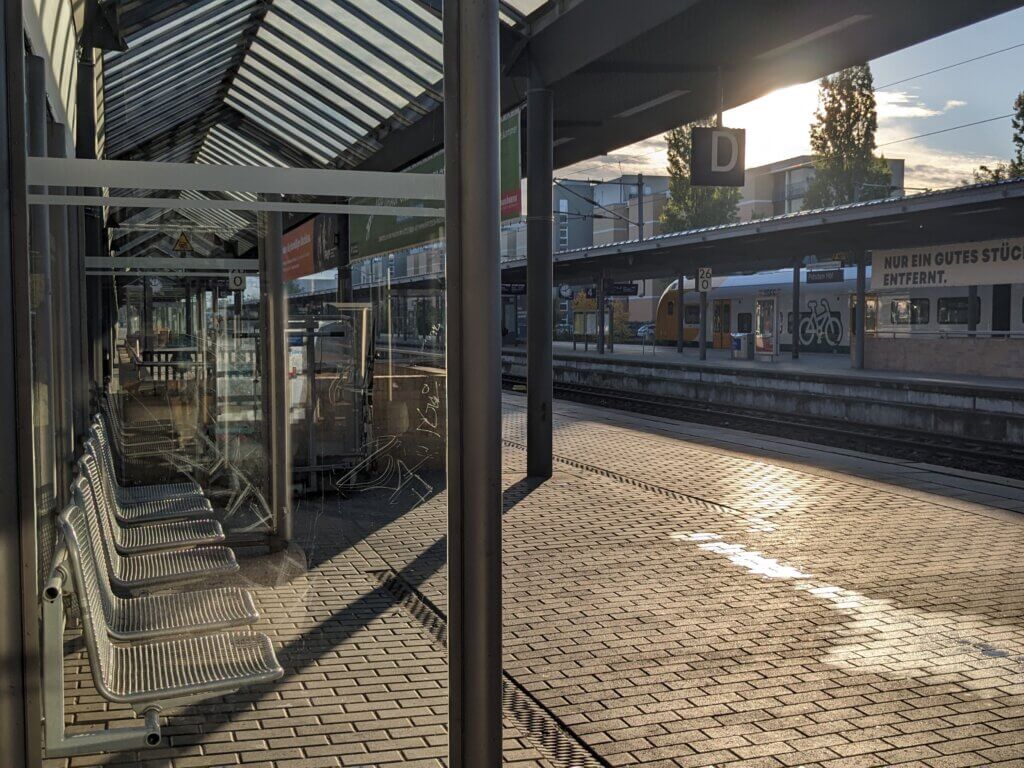
Just in time for the big dance show my dance company was putting on. For rehearsals, I commuted to Potsdam every day for a week and got a taste of the joys of commuting with Deutsche Bahn. Either a train would suddenly be canceled, or it would be delayed so much that you’d miss the next one, or someone would be messing around on the tracks again, bringing train service to a complete standstill. I considered commuting to Potsdam by car instead, but quickly dismissed the idea. Way too expensive.
The dance theater premiere went well. That night, however, I developed a sore throat and had to admit to myself that I couldn’t keep dancing like that. So I stayed in bed and missed not only the remaining performances of the dance show but also my first week of university. I had such high expectations for the start of my master’s program and still missed all the orientation events.
All the more motivated, I headed to Potsdam the following week. I had chosen my courses so that I “only” had to commute to Potsdam three times a week. In addition to the required modules Quantum Mechanics II and Solid-State Physics II and the advanced lab, I took Multimessenger Astrophysics and the Physics of Solar Cells. I found both elective courses exciting; however, I was most curious about my new lab partner.
She had been assigned to me via email because I hadn’t attended the orientation session. I quickly found out that she wanted to study in Paris next year, which led to a brief (written) conversation between us. We met for the first time after a lecture we both attended. She suddenly stood in front of me and asked: “You’re Maja, right?” and when I nodded, she slipped a note with her cell phone number into my hand.
She had to go, but we could definitely chat longer some other time. And just like that, my lab partner was gone. And I, being face-blind, hadn’t noticed what she looked like. Only that she was taller than me and had dark hair. Great memory, Maja…
During this second week of classes, I quickly realized that commuting even three times a week was very exhausting. It was a good thing that it was only a 5-minute bike ride from the Bernau train station to my apartment. It still felt strange to stay in the city, since I had gotten so used to living out in the village. After the exhausting move-in phase, I was optimistic that things could only get better and that I’d get used to the apartment over time.
But Ie reckoned without the neighbor below us. At two in the morning, he decided he had to listen to loud music. Since he didn’t respond to our knocking, the police had to come before things finally quieted down. Unfortunately, it didn’t stop at just one incident. Instead, our neighbor turned every night into day and didn’t understand that even loud talking could be quite disruptive in a thin-walled old apartment building.
After several sleepless nights and numerous attempts by our landlord to contact him (who, unfortunately, never managed to reach the neighbor…), it became clear to us that our critical living situation wasn’t going to change anytime soon. The big bubble of hope for a cozy apartment of our own, for a place of retreat after the stressful daily commute, began to crack.
Deep down, I still refused to entertain the thought of giving up the apartment. But when the situation still hadn’t changed by early December and we spent the night away from our apartment for the second time just to get some sleep, it became clear to me too: The bubble had burst. We couldn’t stay in the apartment.
In English please
I can only vaguely recall what happened during those first few months at university, as the difficult housing situation overshadowed everything else. At first, I had a lot of catching up to do. For example, I realized that my knowledge of quantum mechanics from the third semester had all but vanished, so I spent days watching YouTube videos and poring over old textbooks to make up for the gap and get off to the best possible start in Quantum Mechanics II. I did the same for Solid-State Physics II.
Even though the courses were structured almost identically to those in the bachelor’s program—there were lectures, weekly worksheets, and exercises—each instructor strictly followed their own plan. And that plan wasn’t always effective. After just one Solid-State Physics II lecture, I decided to stop attending. The professor spoke so incoherently that I could barely grasp any of the content. And since I’d discovered that he was essentially just following a specific textbook, it turned out to be much more efficient to simply study the weekly topics on my own.
The theoretical physics lecture was better structured and came with a comprehensive set of notes covering all the important content. So even if I missed the lecture, I always had good, complete notes. That doesn’t mean I really understood what was being taught. Unfortunately, there are hardly any books in this field that explain the subject clearly. Without YouTube videos and ChatGPT, I probably would have dropped out completely after the first few weeks.
Getting into solar cell physics was much easier for me. Finally, I felt like I was applying my knowledge to something practical. The conversion of light into electrical energy is of great importance for our future, but it also requires a lot of research to develop solar cells that are as efficient and sustainable as possible.
The lecture itself was held in English, and because of the many terms I didn’t know, it wasn’t uncommon for me to only recognize the main point based on the slide title. But with a little time and effort, I was able to catch up. And the more I delved into the subject, the more pieces of the knowledge puzzle fell into place to form the bigger picture. It was a wonderful feeling. The fact that the lecturer spoke about his field of research with such enthusiasm rubbed off on me. Perhaps that was the path I would take after my master’s degree.
I was also able to pursue my initial interest in astrophysics. Multimessenger astrophysics studies astrophysical phenomena using four different channels of information: light and other electromagnetic radiation, neutrinos, cosmic rays, and gravitational waves. Unfortunately, I lacked the foundational knowledge for this deeper understanding because, as I soon realized, I was the only student in the general physics master’s program.
While the other astrophysics students eagerly asked questions about the sometimes very sporadic coverage of certain lecture topics, I was still busy trying to understand the questions themselves. But, I kept telling myself, things could only get better if I stuck with it.
In addition to the courses, I had to prepare two presentations for an experimental physics seminar, which were intended to teach us how to give presentations and process information. I structured the first, shorter presentation on the topic of “surface plasmons”, because ever since I had written my bachelor’s thesis on localized plasmons in tiny nanostructures, I had found these electron oscillations incredibly fascinating. It was as if it were now my task to gain a more comprehensive understanding of plasmons.
Preparing the presentation was fun; it was only the seminar leader’s specific requirements that made me feel like I was designing her presentation rather than my own. Many of my classmates presented in English. But even though my academic English was getting better and better (simply because almost all courses were now held in English), I didn’t want to go down that path of extra effort. I did, however, admire the other german students for whom the English language came so easily.
A Real-Life Soap Opera
It was harder for me to keep up with all my courses during the Christmas season. Christmas had always been stressful in recent years, because juggling university with all the Christmas preparations was often a Herculean task. This year, on top of that, we had decided to give up our apartment again. On December 3 – after only three months – we handed in our notice to move out at the end of February.
This had not been an easy decision; after all, we didn’t have many options. Finding another affordable apartment so quickly was – as we had already realized six months earlier – virtually impossible. On top of that, we were afraid of having problems with neighbors again. This constant moving around couldn’t go on forever.
Luckily for us, my parents-in-law had noticed our sleepless nights and offered to let us move in with them permanently. For weeks, we went back and forth: Could we really make living together work and make it pleasant? Did we want to give up the freedom of our own apartment?
We created an Excel spreadsheet where we compared our housing options across various categories like space, noise, cost, etc. It became increasingly clear that nothing was keeping us in our apartment. At my boyfriend’s parents’ house, we would have our own living room, a private bathroom, and a bedroom. We also wanted to bring our kitchen with us and install it in the basement. In essence, we had our own two-room apartment within the house.
This decision may have taken away the idea of having our own apartment. But on the other hand, it opened up a whole range of freedoms that wouldn’t have been possible with an apartment: the financial burden was gone. We were allowed to use the garden and lived surrounded by three small woods. We had company when we felt cooped up on lonely evenings. And most importantly, we could finally sleep peacefully.
But the hard work wasn’t over yet, because within the next three months, we had to manage another move on top of our daily stress. We were living half in the apartment and half at my in-laws’ house. So I was now commuting between three locations. On top of that, every spare minute and the weekends were spent packing. That’s how we managed to move the “essentials” (like our sleeping and work areas) into our new home before Christmas Eve. We wanted to use the holidays to wind down a bit so we could start the new year with as much energy as possible.
Then my boyfriend got sick again, which pretty much ruined Christmas for us. The days off just slipped by without us really being able to make the most of them. Instead, there was plenty of time to think. The past few months had been anything but pleasant. Although we were happy with our decision to move again, the four months of constant stress had taken their toll. I barely thought about college – which had pretty much been the center of my life in recent years – during those days.
When we sat together with friends on New Year’s Eve and talked about the past few months, I felt like the main character in a daily soap. Every day was different, and a new challenge awaited around every corner. How fortunate that we had such loving people around us who supported us and motivated us to keep going.
Major Projects
I carried this motivation and the thought that things would calm down starting in March into the new year. I still had a few university assignments left over from December that I wanted to finish before classes started. I had two longer presentations coming up: one in solar cell physics and the second in the experimental physics seminar.
The solar cell presentation was exciting to prepare because it covered a new technology that we hadn’t covered in class yet. Unfortunately, I really had no choice but to give it in English. So I wrote my text on index cards in long bullet points – my old German teacher would surely have called these sentences ^^. I also made sure to include phonetic spellings for the more difficult English terms.
It was one thing to listen to a lecture in English. Pronouncing the terms myself was something entirely different. I practiced reciting it many times. When I finally gave the presentation, I stumbled over my words several times, but since other students had similar experiences, it didn’t seem so bad to me anymore. In the end, I handled this one and the second presentation very well.
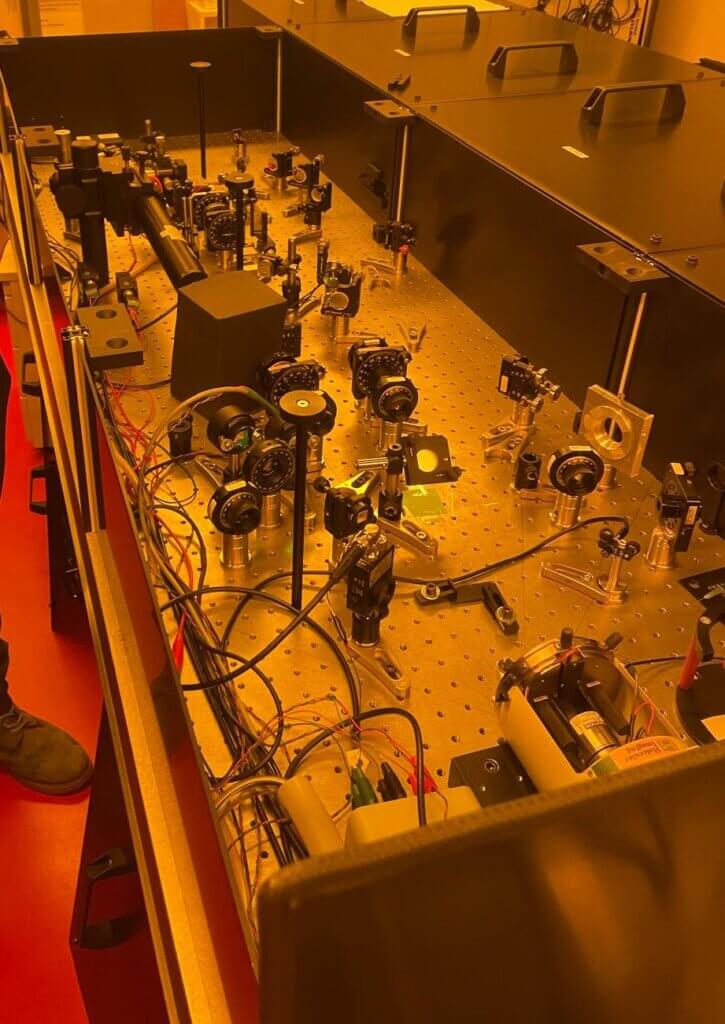
For the latter, I was assigned a supervisor, since we were supposed to report on a current research topic from the university. Since I chose “plasmon-controlled chemistry,” I ended up in the same research group as before during my bachelor’s thesis. So I got to chat with my old advisor again and felt so at home, as if I were still coming and going within the group.
I was asked if I would also write my master’s thesis in the research group. I was welcome to do so. I had already thought about it, but since I saw myself more in climate physics, I declined. I wanted to try something new, because even though plasmons had really caught my interest, I didn’t plan to stay in solid-state physics.
It was all the more exciting that I was able to observe surface plasmons in action during one of our advanced lab sessions. If only the experiment report weren’t 20 pages long… I had agreed with my lab partner (yes, I had finally memorized her face after the third meeting) to split up the lab reports. That meant she would write three reports out of the six labs, and I would write the other three. This wasn’t exactly the most intensive form of teamwork. But since we both were always busy and found it hard to coordinate, this was a welcome relief.
Once the three major projects were finished, I was able to focus on my usual university work again, but was horrified to realize that the first exam was only four weeks away. A mountain of exam preparation loomed in my mind’s eye, and I thought back to the first semester. Back then, we were advised with complete conviction to start preparing at least eight weeks before the exam period. That wouldn’t have been possible now.
I had already had to significantly scale back my university workload. I no longer solved all the practice problems on my own if I knew a sample solution would be provided. I no longer attended every lecture, but only traveled to Potsdam on Tuesdays when three courses were scheduled back-to-back.
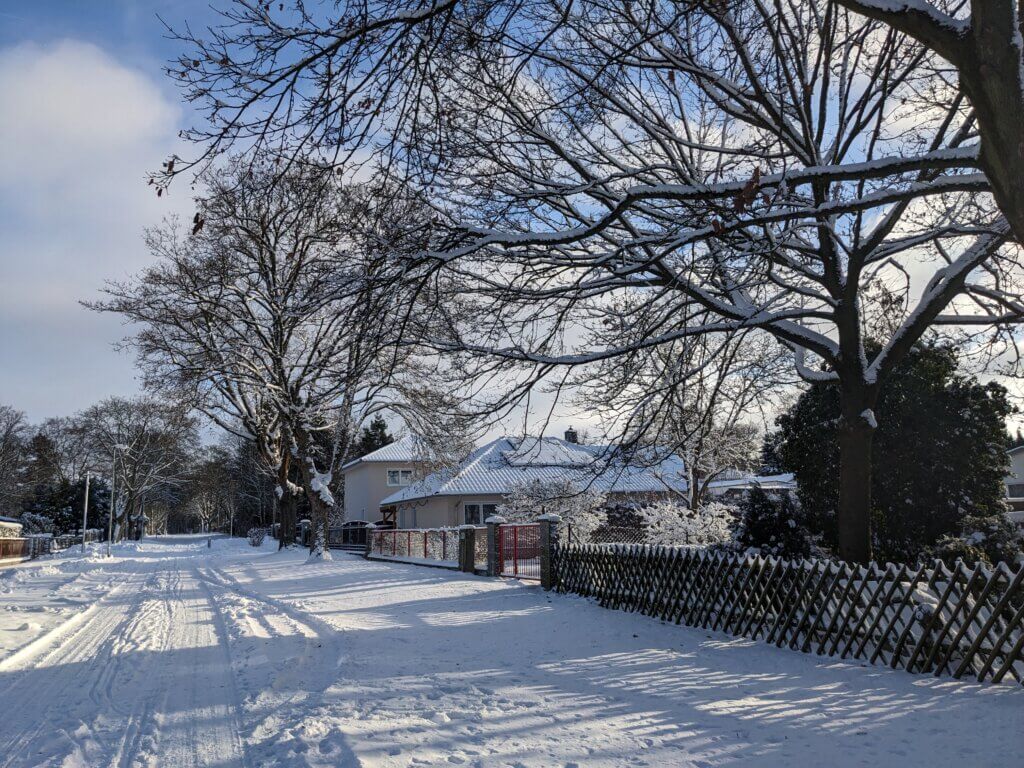
Then, when there was an extreme amount of snow in January and the snow removal service completely failed, I sometimes stayed home the whole week. Once, I waited for two hours at various train stations in minus 6°C weather because there were numerous delays and cancellations. I wasn’t going to put myself through that a second time.
That gave me a little more time to tackle the final tasks of the move. With my parents’ help, we dismantled the kitchen and the last large pieces of furniture and transported them to our new home. Fortunately, there wasn’t too much left to do, since we had already done a lot of the groundwork.
At the end of January, with the help of friends, we repainted the three walls – whose colors we’d spent hours choosing back in September – back to white. On February 9, we handed our first apartment back to the landlord. Since we’d long since moved on from the apartment, saying goodbye wasn’t hard. Rather, it was a relief to be rid of the burden of that apartment, which had such negative connotations, and to be able to focus on other things again.
Constant Snow and Constant Stress
All the stress outside of university didn’t lead me to completely neglect my studies. Rather, it forced me to stop attaching so much importance to it. Although I spent less time studying, I still studied intensively. For the solar cell and astrophysics courses, I had started during the semester to review the lectures thoroughly enough to fully understand the content and summarize it in an overview.
Solid-state physics and quantum mechanics had fallen a bit by the wayside. Although I had always taken diligent notes, some of the material had gone over my head. At the end of January, I began to study the lectures intensively from start to finish. It took me two weeks to (almost) fully understand the solid-state physics material and write it down in a 45-page summary.
The quantum mechanics material put even more pressure on me, because by then the lecture period was almost over and I could count the days I had left to prepare for the exam. Now that the apartment stress was gone, I could devote myself more to studying again. And my inner ambition pulled me in a direction that created a new—yet all-too-familiar—source of stress.
It took a lot of willpower to close my laptop and switch off after long days of studying. Unfortunately, the weather didn’t help much, because after a month of continuous snow, the temperature still wouldn’t rise above 0°C. So all I could do was drink tea with a good book in hand and try not to think too much about the next day.
The situation eased somewhat when one of the four exams was postponed. My study schedule worked out reasonably well, so I went into the solid-state physics exam with a clear conscience. I fought my way through Berlin by car to get to the Lise Meitner Campus in Berlin-Wannsee, where one of the professors worked and the exam was to take place.
I didn’t know either of the professors, since I hadn’t attended the lecture, and was all the more anxious about what lay ahead. At the campus entrance gate, I had to fill out a visitor form. “Because the facility used to work with research reactors, all staff and visitors are strictly screened,” explained the friendly man who led me from the entrance gate to the exam room.
I was there way too early, so I had plenty of time to get very nervous. The examiners were both friendly and said I was the first person in the course to take the exam. There wasn’t much time for small talk; instead, I was immediately asked a question about a specialized topic I had chosen (we had been able to select two such topics in advance and of course one I chose was „plasmons“). I stumbled a few times and made it harder on myself than necessary, since I started explaining the quantum Hall effect when asked the simple question about the normal Hall effect.
I must not have done too badly after all, because the examiners gave me a 1.3. I also think I got a little extra credit because the professor knew I’d taught myself everything. I was relieved. All the hard work had paid off, and the exam was over faster than I’d expected. 1 out of 4 done.
Somehow passed
For the next exam, advanced quantum mechanics, we were given an assignment to solve on our own at home and then present in the exam. I set aside a Saturday for it and conscientiously worked through the tasks with the help of ChatGPT. That doesn’t mean I just copied whatever the chatbot spouted out. Rather, I tried to understand what it was doing and at the same time verify whether its statements could be correct.
ChatGPT is not a tool you should blindly trust. It can only compile content, but it cannot perform calculations on its own or even think independently. So, step by step, I worked through sub-tasks a) and b), asking it to explain once again how to multiply matrices. I should have known this since my first semester, but somehow I had managed to push this knowledge out of my head time and again.
Anyway, I didn’t run into a problem until sub-task c). There, I had to calculate the partial transposition of a matrix and had absolutely no idea what that was. Since we didn’t have any books on the subject, the internet isn’t much help with this kind of advanced math, and ChatGPT kept spitting out something different every time. I sat over the problem for several hours, repeatedly discarding my solutions because none of them looked right.
It was almost 6 p.m. by then, and I had to call it a day, even though I hadn’t finished the problem. That left me with an uneasy feeling. So, contrary to my own intentions, I sat down to tackle the problem again on Monday, my head still spinning. I spent three hours of the day trying to solve the problem.
And sure enough: at some point, I discovered the correct definition of partial transposition in the lecture notes and realized that ChatGPT had spewed absolute nonsense. I solved the problem based on my own understanding and was now able to focus on studying the rest of the material, though I still felt a bit unsure. I now had only a day and a half left to master all the material AND tackle the last and hardest chapter: relativistic quantum mechanics. Since I hadn’t gone to university in the past few weeks, I hadn’t even started on that one yet.
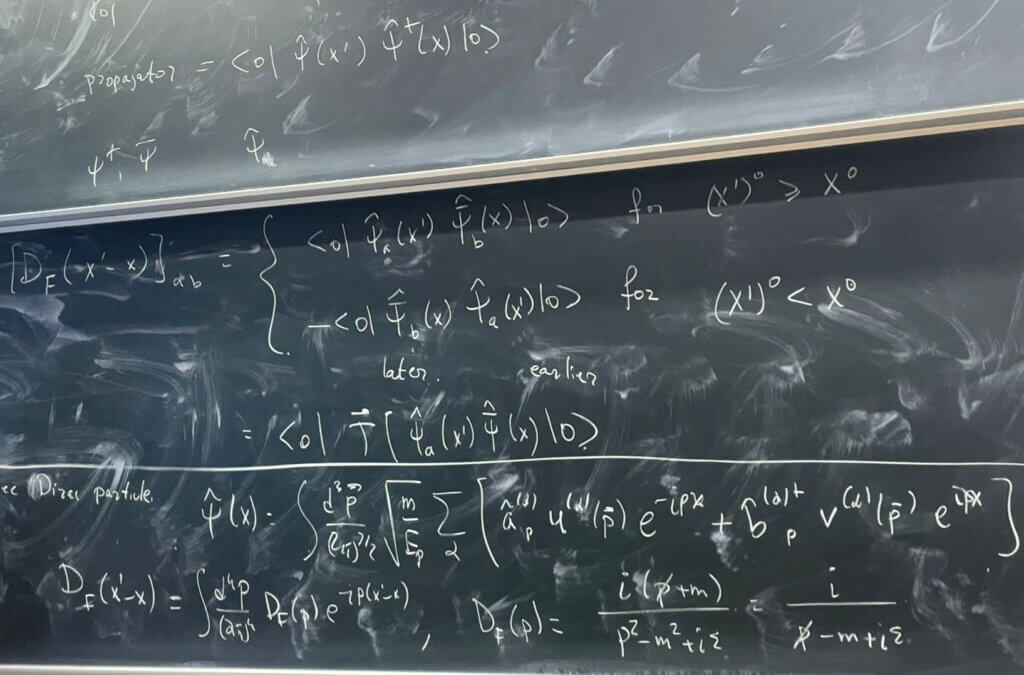
That made me all the more nervous as I sat across from the two examiners on Wednesday. I explained my solution to the problem in English and was quite surprised when they told me how well I’d solved it. And since I apparently was so good at math, they asked me to work through a more advanced problem on the board right then and there. I got extremely nervous. I had no idea what to do. It wasn’t until the examiners began to break down the steps for me that I was able to follow them and solve the problem.
There wasn’t much time left for follow-up questions, so we moved right on to relativistic quantum mechanics. Somehow, I managed to stammer out a few formulas from the subject area I’d crammed the day before and walked out of the exam with a 1.0. What had just happened?! The subject I’d almost failed in my bachelor’s program and that had caused me such anxiety was supposed to be my best?
The examiners asked me if I wanted to write my master’s thesis in their department. But just as I had been asked in the solid-state physics exam, I said no. These were definitely not my areas of interest, even though I was proud to have mastered the courses so well. 2 out of 4 done.
It better be fun
The next exam involved memorizing the basics of multi-messenger astrophysics and turned out to be more exciting than I’d expected. I hadn’t realized beforehand that in 2017, for the first time, the merger of two neutron stars had been observed via gravitational waves and various forms of electromagnetic radiation. What an enormous source of information that must have been for astrophysicists, who, until just a hundred years ago, could do nothing more than observe the sky with the naked eye.
The exam day itself went smoothly: two hours by train to Golm, a half-hour exam, two hours by train back to Bernau, then some downtime. 3 out of 4 done. I had once again performed very well and now had a few hours of rest before studying for the final exam the next day: Solar Cell Physics. Unfortunately, I only had the weekends left to prepare for the exam in a week and a half, since I had a seminar in Potsdam the following week – it was now March.
I was dreading this seminar, or rather: the commute, because for the next five days I would be at Telegrafenberg in Potsdam every day from 9 a.m. to 5 p.m. sharp. So I got up at 6 a.m. on Monday to catch the bus just before 7 a.m., arrive at Potsdam Central Station at 8:38 a.m., and barely miss the bus up to Telegrafenberg there. So I trudged at a brisk pace up the hill, which is 96 meters above sea level.
Completely sweaty but happy amidst the green mountains, I arrived at the “Albert Einstein Science Park,” where I had taken my climate history exam a year earlier in front of two true luminaries of climate research. Up here, other researchers from the PIK (the Potsdam Institute for Climate Impact Research) were also working. And I now had a seminar with one of them on the dynamics of the climate system. In English, of course.
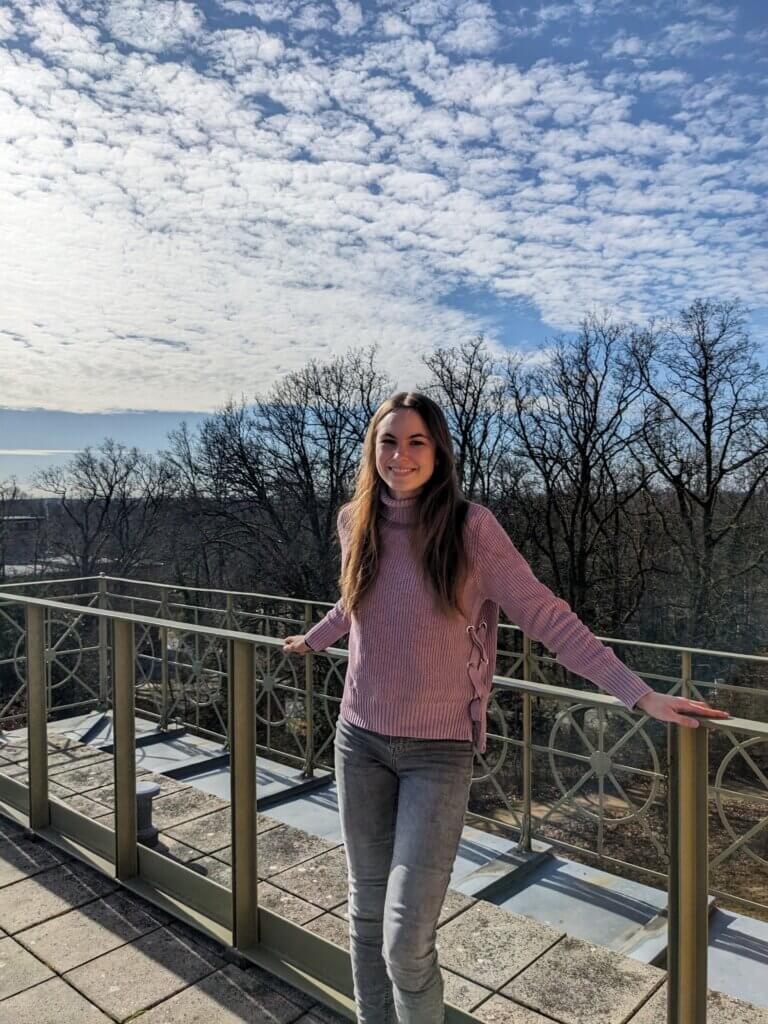
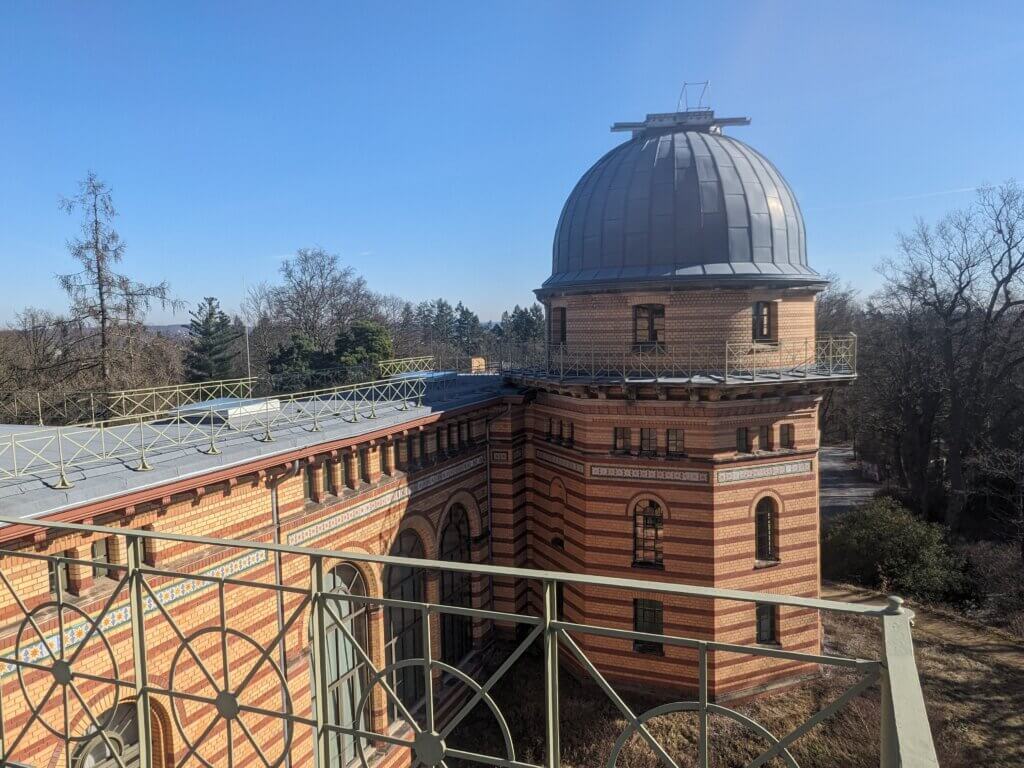
I arrived a bit late, but I was quite amazed to find that our lectures were taking place in a large dome of the Michelson House, in whose basement Albert A. Michelson (Nobel Prize 1907) conducted his significant measurements in 1881 on the relative motion of the Earth against the hypothetical ether – results that became the foundation for Einstein’s theory of relativity. The dome and the terrace of the building were magnificent, making the long drive here just a little bit more worthwhile.
The lecture wasn’t quite as magnificent. Although the professor probably had some idea of what he was talking about—we didn’t. Without a script and with only a few key points, he explained formulas and concepts, and it was up to us to jot down the main points. At the beginning, he said: “It better be fun. Because we don’t get paid enough for it not to be…”
He, however, had the most fun. He liked to drift off into political topics or talk about colleagues he’d met years ago. It was up to us, the professor said at the end of the week, to delve deeper into the topics if we wanted to do well on the exam. This seminar was intentionally kept very casual.
The supervision of our assignment was also very relaxed (which is not a good thing). After the morning lecture, we were given three hours every day after lunch to work in small groups on a more in-depth assignment, which we were then to present on Friday in a twenty-minute presentation. At first, we were pretty clueless, because using only one source, we were supposed to convert a stationary climate model into a dynamic one (i.e., one that evolves over time) and simulate the results.
It was only with the help of detailed instructions from the professor and a PhD student – mind you, on the very last day before the presentation – that we managed to simulate a running model. Much more satisfying than completing the assignment, however, was the collaboration with my group members. I worked with a Mexican woman and a Spanish man, two open-minded young people with whom I enjoyed spending my lunch breaks and exchanging views on Germany and the world.
Although we were from three different countries and three different degree programs, we got along great, which made the long workday from 9 a.m. to 5 p.m. fly by. Since I was also able to stay with a friend in Potsdam for two nights, time just flew by, and at the end of the seminar week, despite the poor lectures, I didn’t regret making the trip. I wouldn’t take the exam for this until later in September, since I planned to take the second seminar for this module only then. So now there was just one exam left, and hopefully the stress would be over in a few days.
Solar Cells and Surgery
In fact, I had plenty of time the following week. Just not in the way I’d expected. On Monday, I studied all day and ignored the stomach cramps that started at noon. I had put together a thirty-page overview for the solar cell exam the next day; and since I found the topic very interesting, it was almost fun to memorize the mechanisms and technical implementations of solar cells.
Around 5 p.m., I felt well-prepared. I not only put my work aside but also lay down on the sofa, because by then the stomach cramps had become really uncomfortable. My condition got worse and worse throughout the evening, and the next morning I had an unpleasant, constant pressure in the lower middle abdomen. It was clear to me that the exam wouldn’t take place today.
So I drove to the doctor’s office at 8 a.m. and, while still in the waiting room, sent a quick email to the examiner, who, fortunately, simply postponed the exam for the time being. After waiting for two hours, I was sent to the emergency room with a suspected case of appendicitis. So I packed my bag, had myself taken to the emergency room, and spent the next five hours undergoing three ultrasound exams and waiting. They admitted me to the hospital. By then, I had completely forgotten about the exam.
The next day, an MRI confirmed the suspicion of appendicitis. I knew this meant an appendectomy. Since the surgery was scheduled for that afternoon, I spent the next six hours—again, waiting—mentally preparing myself for the upcoming procedure.
I woke up in the hospital that evening from the general anesthesia, completely disoriented. I could barely move because of the pain. When the doctor came to see me the next morning to tell me that everything had gone according to plan, I breathed a sigh of relief. And I was really looking forward to breakfast, because I had barely eaten anything in the last three days. After two days, I was discharged from the hospital. The exam was postponed to April 1, so I had enough time to rest over the next two weeks and really do NOTHING for once.
A week has passed since then. Doing nothing is hard, but in this case, it helped that I could only move around to a limited extent at first. I wrote a list of things I wanted to get done during those two weeks. No pressure, just ideas. Above all, I wanted to work on this blog again.
You may have noticed that since I started studying, I’ve been posting almost exclusively during semester breaks. During the semester, my studies always kept me so busy that I didn’t feel like focusing on anything else during my limited free time. This semester was different.
While I had consciously tried not to place too much importance on university in recent years, life had now forced me to turn my attention to other, important aspects of life. Above all, my health and the support of friends and family. My own life.
I’m learning in all areas. I still love physics, but I love my free life even more. I’m now looking for job opportunities after I finish my master’s degree, making sure above all that I have enough time for myself. Ideally, I’ll still be able to make the world of physics a little more understandable for you. And if I can’t do that in my future job, then I’ll just keep writing on this blog.
My studies at Potsdam University
Here you can find the other articles from my time at university in Potsdam:
- Live or study? – The highs and lows of my first exam phase (2022)
- University life – 2nd attempt, or: Trying to survive
- Semester 3 & 4 – Being on the same (Compton) Wavelength
- The normal madness and the joys of cycling – semesters 5 & 6
- Quantum, cows and paleoclimate – An update on my 7th semester
- Four years of bachelor’s studies – a dignified end?
- Light quanta and sunburn – An introduction to quantum physics 2024
- Double Burden – Studying and working in Potsdam in 2022
- The World of the DPG 2021 – Physics, Journalism and Me