

Reading time: 25 min
THINGS TO KNOW If you’re interested in studying physics in Germany but aren’t sure whether the bachelor’s program is really the right choice for you, you’ll find a practical overview here: from the program’s structure and content to requirements and career prospects, as well as a sample study plan and personal insights.
My name is Maja Ruprecht, and I studied the single-subject Bachelor’s program in Physics at the University of Potsdam from October 2021 to August 2025. In this article, I provide insights into the structure, content, and challenges of the program and outline my personal academic journey. My aim is to help prospective students assess whether a physics degree aligns with their interests and abilities. This overview is based both on the recommendations of the German Physical Society (DPG) and on my own experiences at the University of Potsdam.
Note: It is generally difficult to pursue an undergraduate degree in physics in Germany without proficiency in German. While advanced and specialized courses – particularly at the graduate level – are often offered in English, foundational undergraduate instruction is in most cases conducted in German. Only a very limited number of exceptions exist, such as the International Physics Studies Program (B.Sc.) at Leipzig University, which is taught entirely in English.
1 What a Physics Degree Is
A physics degree provides a deeper understanding of the fundamental laws of nature—from the smallest atomic scale to the vast dimensions of the cosmos. Here, students learn to investigate physical phenomena both theoretically and experimentally and to describe them quantitatively. The program opens up numerous paths into research, technology, and industry.
1.1 What is physics?
Physics is the natural science that investigates the fundamental laws of matter, energy, motion, and their interactions. The goal is to describe the world and the universe based on a few fundamental principles. It can explain phenomena at the atomic level, in the classical macroscopic world, and even on cosmic scales.
Physics encompasses fields such as mechanics, electrodynamics, thermodynamics, and quantum physics, but is also closely linked to other disciplines. Examples include the fields of biophysics, astrophysics, and environmental physics. The integration of mathematical models with fundamental physical laws generates insights that enable technological innovations, facilitate the development of novel products, and can contribute to solving the “great challenges facing our society” – for example, in the energy turnaround, medical technology and health research, or in information and communication technologies.

1.2 Key Facts About Studying Physics
A physics degree program typically begins with a three-year bachelor’s degree, which can be followed by a two-year master’s degree. There are various types of physics degree programs:
- Teacher training program: Qualifies you to become a physics teacher. It is a combination of physics, a second subject, and teaching methodology courses. The structure varies depending on the type of school and the state.
- General physics program: A traditional physics degree. Provides a comprehensive overview of fundamental concepts.
- Specialized programs: Focus on a specific area of physics from the start, such as biophysics or climate physics. Specialization in these areas may also begin at the master’s level.
- Physical Technologies: Practice-oriented programs at universities of applied sciences. Many graduates transition directly into industry.
This article focuses on the General Bachelor’s degree program in physics. Upon completion, students are awarded a Bachelor of Science degree. The program comprises 180 credit points, which corresponds to a standard duration of 6 semesters. In practice, however, the program typically takes 6 to 10 semesters to complete. Admission to the program is generally open, but a high school diploma or equivalent is required. This typically includes a German Abitur or a Fachhochschulreife. Individuals with professional qualifications or holders of foreign high school diplomas may also be admitted under certain conditions, provided that the respective credentials are recognized.
1.3 Content and Core Competencies
In the Bachelor’s program in Physics, students acquire all the fundamental mathematical, analytical, and experimental skills necessary for a professional career or a Master’s program. The program combines theory, experimentation, and computation.
The goal is to recognize physical principles, develop models, and formulate phenomena quantitatively. Mathematics, as the “language of physics,” also plays a significant role in this process. Graduates possess a broad foundation of knowledge in physics, mathematics, and related disciplines. Through internships, students are also introduced to experimental work as well as methods of data collection and computer-aided analysis, enabling them to confidently apply experimental methods and systematically analyze and interpret their results.
The core content includes:
- Basic knowledge of theoretical and experimental physics in the areas of mechanics, thermodynamics, electrodynamics, atoms and molecules, solid-state physics, and quantum mechanics.
- Knowledge of advanced mathematics in the areas of analysis, linear algebra, vector calculus, probability theory, and statistics as a foundation for later modeling, analysis, and simulation of physical systems.
- Laboratory courses serve to develop experimental skills ranging from areas of classical physics (in the introductory lab) to modern physics (in the advanced lab).
- Elective modules for initial specialization cover specific areas of physics or mathematics, computer science, and chemistry, extending to the engineering sciences. The range of elective options varies from university to university.
- The bachelor’s thesis is the first independent scientific paper. It is typically completed at the university or at cooperating research institutes under the supervision of a professor.
2 Career Paths After a Bachelor’s Degree in Physics
With a Bachelor of Science degree, graduates earn their first professionally qualifying academic degree, which opens up various career paths. The question arises as to whether to pursue further studies or enter the workforce directly. In principle, a direct entry into the workforce is possible, particularly in applied or technological fields.
However, according to the DPG, better career opportunities are only available after completing a master’s degree. This offers greater specialization and exposure to current research questions. Students increasingly work independently on scientific projects, allowing them to deepen their methodological skills in theory, experimentation, and simulation. The Master’s program can be pursued in traditional fields or in interdisciplinary areas such as astrophysics, materials science, or data science.
With a Master of Science degree, graduates have good career prospects in both traditional natural science fields and in technology-, data-, or business-related fields. For example, they may find employment in IT, materials science, science communication, or medical technology. Jobs in mathematics and programming are also possible, as are positions in management consulting, the financial sector, government ministries, or environmental institutions.
Those interested in a position in research or in challenging development fields can pursue a Ph.D. following the Master’s degree. This involves several years of independent research on a specific topic, leading to the award of a doctoral degree and opening doors to both academic careers and highly specialized roles in industry and research.
A career in higher education is generally unpredictable and heavily dependent on the success of one’s own research projects as well as on external factors such as third-party funding. It can be characterized by long periods in temporary positions and on fellowships and therefore involves some uncertainty. Nevertheless, a career as a tenured academic staff member or professor is also possible, albeit competitive. Compared to industry, however, academic salaries—especially in the early stages of a career—are often lower.
In summary, the traditional fields of work for physics graduates include:
- Science and research at universities and non-university institutes,
- Research and development in industry, particularly in high-tech and IT sectors,
- Software development, data science, and IT-related roles,
- Consulting, management, and administration,
- Patent offices, government agencies, and ministries,
- The financial sector, as well as technical supervision and quality assurance,
- Science communication and teaching.
3 What You Need
You don’t have to be a “high achiever” to study physics. You need a high school diploma, which is usually the Abitur. At universities of applied sciences, a vocational diploma or an equivalent vocational qualification is often sufficient. Specific requirements may vary depending on the university or college, so it’s worth checking directly with the institution you’re interested in. A minimum grade requirement (Numerus Clausus, NC) is not required for most physics programs.
Since the program starts from the ground up in terms of physics and does not build on high school material, it is not a disadvantage if you did not take “Physics” consistently in high school. However, a basic understanding of physical concepts and formulas is helpful, as the program progresses quickly. Of course, you should also have a certain interest in physics, physics-based technologies, or specific research areas to stay motivated.
Solid math skills are crucial. While there are bridge courses to prepare you for the program, these build on high school knowledge, so a good basic understanding of math is essential to successfully handle the material in the program. Analytical thinking and the ability to think abstractly are also advantageous.
For any degree program, the ability to work independently and in a structured manner is crucial; curiosity and quick comprehension are equally important. A physics degree program is complex in content, which is why perseverance and the ability to handle frustration are essential for success.
Additional advantages include a basic knowledge of chemistry, programming, and English. While these skills can be developed during the course of study, a B2 level of English is often required later on. An openness to making new friends and working in teams makes the program much easier, and internships are generally completed alongside lab partners.
The most important thing, however, is your approach to the program. You must be aware that it is a demanding full-time program. Yet, “those who take their physics studies seriously will, in most cases, be able to complete them successfully” (German Physical Society. [n.d.]).
4 Study Options in Germany
The variety of study options in the field of physics in Germany is vast: As of March 2026, nearly 60 universities as well as more than 25 universities of applied sciences and colleges of applied sciences offer physics or physics-related degree programs.
Those seeking an overview of all study locations can refer to the offerings of the Conference of Physics Departments (KFP) for universities and the Association of Physics Technology Departments (FPT) for universities of applied sciences. These organizations also provide the Physics Study Atlas, which lists all physics degree programs in Germany and allows users to filter results based on specific criteria.
The main differences between universities lie in their size, their urban or rural location, and the composition of their student bodies. The quality of teaching and the physics curriculum, however, are comparable across all institutions nationwide. A bachelor’s degree in physics generally opens the door to transferring to another university for a master’s program.
To get an accurate picture, it makes sense to look not only at general information but also at the specific research and teaching offerings of the institutions. Research priorities are particularly relevant, because where a field is strongly represented in research, there are usually also specialized lectures, bachelor’s and master’s theses, and dedicated faculty members. You can also factor in aspects such as modern internships, project work, study abroad programs, and further specializations when making your decision.
In addition, the CHE university ranking offers a broad overview of various criteria that can be helpful when choosing a place to study. This ranking thus provides a nuanced assessment of locations based on factors that are important to the individual. The DPG, however, expressly advises against using other university rankings, as they are often misleading.
5 How a Bachelor’s Program in Physics Works
The following section provides a detailed overview of organizational procedures, module structure, and course content. While based on experiences at the University of Potsdam, this description is designed to be applicable to similar bachelor’s programs at other universities.
5.1 General Organizational Structure
The Bachelor’s program is a full-time program designed to be completed in six semesters. It is divided into modules, each of which is assigned credit points (CP). In theory, one credit point corresponds to 30 hours of work. Students are expected to earn 30 CP per semester, resulting in a total of 180 CP for the Bachelor’s degree.
In practice, earning 30 credit points per semester is a challenge, as the associated workload is very high. Consequently, it usually takes eight or more semesters to complete the degree, especially if students are working alongside their studies. Failing exams can also extend the program by one or more semesters.
The academic year is divided into a winter semester (from October to March) and a summer semester (from April to September), which are largely identical in structure. The course offerings in the summer and winter semesters can vary significantly. Each semester typically comprises 15 weeks of lectures (lecture period), followed by a break of about 10 weeks. However, this break is not only for rest but is primarily used for exams, intensive seminars, internships, or the completion of coursework.
The program is organized through a central campus management system. Within specified timeframes, students must register for courses at the beginning of the semester. Depending on capacity limits, admission to courses may be required. Registration is necessary both for attending classes and for the subsequent accurate recording of completed coursework.
Before the start of the first semester, voluntary bridge courses are often offered, particularly to review mathematical fundamentals. The actual start of the program is accompanied by introductory sessions and orientation weeks, which include not only organizational information and tutorials but also social integration activities such as group activities.
Daily academic life during the lecture period is characterized by various teaching formats. These include, in particular, lectures for conveying theoretical content, accompanying exercises for deepening and applying the content, interactive seminars, and experimental laboratory practicals. Performance assessment during the lecture period is not standard; understanding and participation are assessed only indirectly through the submission of exercise assignments. Successful completion of exercise assignments may be a prerequisite for admission to the final module exam.
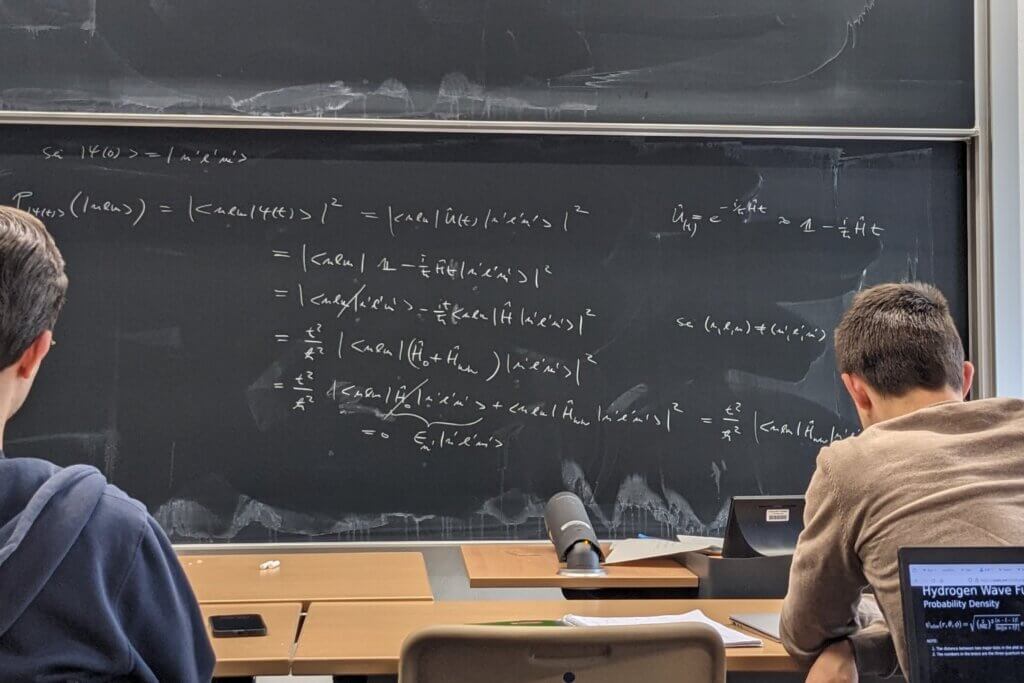
Exams generally take place during a concentrated exam period at the end of a semester. Here, too, timely registration via the campus management system is required; and likewise, a corresponding withdrawal is required if the exam cannot be taken. Depending on the module, exams are conducted in oral or written form. The grades earned are then recorded in the system and contribute to the credit account as well as the overall grade for the program.
If an exam cannot be taken during the regular exam period or if it is failed, students may take a second exam date, which is usually at the end of the break or at the beginning of the new semester. It is also possible to re-enroll in a course in a later semester and retake the exam. However, the number of exam attempts per module is generally limited to three. A final failure (especially after exhausting the so-called “free attempts”) generally results in the loss of the right to take the exam in that program.
The specific legal framework for examination procedures, retake deadlines, withdrawal regulations, and grading criteria is set forth in the respective study and examination regulations. These are binding and may vary depending on the university and degree program. For the single-subject Bachelor’s program in Physics at the University of Potsdam, the relevant regulations are outlined in the publicly accessible regulations available at this link.
5.2 Curriculum Structure of the Bachelor’s Program in Physics
In addition to formal regulations, the study regulations include a module catalog and guidelines specifying which modules must be completed and to what extent. Often, a recommended study plan is also provided, which outlines a logical sequence of modules while allowing for individual adjustments.
The program is divided into various module areas, each assigned a fixed number of credit points. At the University of Potsdam, the Bachelor’s program in Physics includes required modules totaling 129 credit points, elective modules totaling 21 credit points, career-specific key competencies totaling 18 credit points, and the Bachelor’s thesis, which accounts for 12 credit points.
This structure is designed to first provide a kind of basic physics education and important methodological skills through the required modules, before students can pursue individual specializations based on this foundation.
An important component is the series of courses Mathematics for Physicists I–IV. These courses cover the mathematical fundamentals that are essential for a deeper understanding of physical theories. In terms of content, the modules cover broad areas of calculus and linear algebra, differential equations, vector calculus, and complex functions. An introduction to stochastic mathematics is also provided.
For many first-year students, this area presents a particular challenge, as the presentation is often highly formalized and not very application-oriented. At the same time, mathematics is the central language of physics and is therefore a prerequisite for all advanced content.
In parallel, the series Experimental Physics I–V covers fundamental physical phenomena and their underlying laws. The courses cover classical mechanics, electrodynamics, and optics, as well as an introduction to quantum mechanics and selected areas of particle and solid-state physics. Particularly in the areas of classical physics, lectures are often accompanied by demonstration experiments that vividly illustrate key effects.
A little later, four courses introduce Theoretical Physics I–IV, which formally describes or derives physical systems based on mathematical models. It begins with classical mechanics and electrodynamics, covers thermodynamics, and introduces the fundamentals of quantum mechanics. These modules are designed to enable students to derive physical laws from fundamental mathematical principles and draw conclusions about real-world phenomena.
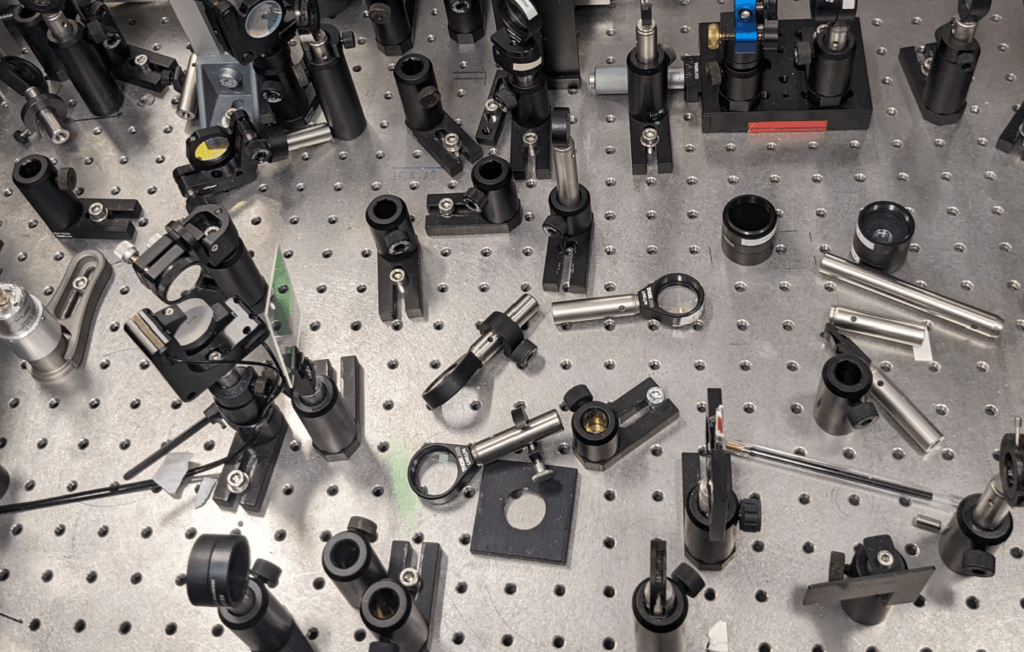
Another important component of the program is the experimental laboratory work. In the introductory lab, students are introduced to the basic principles of experimentation through classic experiments. The focus is not only on conducting the experiments but also on evaluating and structurally documenting the results in the form of scientific reports. Starting in the fifth semester, an advanced laboratory course covers areas of modern physics with more extensive data analysis, allowing students to deepen their specific knowledge of physical phenomena and gain an initial insight into current research.
In addition to required modules, there is a section on profession-specific key competencies. The Methods in Physics module is mandatory. It teaches core methodological skills for scientific work, such as numerical methods, programming skills, and data analysis. The content is developed through concrete problem-solving exercises or small-scale projects, thereby simultaneously training students in practical planning and modeling.
Students begin their specialization by choosing one of five advanced modules. These modules offer specific, thematically related courses in selected subfields of physics. Examples include the physics of condensed matter, photon and quantum physics, and climate physics. The specific courses offered can vary significantly from one university to another.
Finally, there is the category of elective modules, from which students can select courses totaling 21 credit points. This area is designed for individual specialization within their own fields of interest. Students can choose between modules in related disciplines such as biology, chemistry, and earth sciences, or they can expand their knowledge in mathematics or computer science. It is also possible to take an additional advanced module to delve deeper into a specific physics topic.
Once a student has earned a total of 120 credit points, they may apply to have a topic assigned for their bachelor’s thesis. The thesis is often integrated into a research group or an ongoing research project. The topic itself is discussed individually with the supervising professor(s) and submitted as a proposal to the examination committee. Once the committee approves the proposal, the designated completion period of approximately six months officially begins.
The goal of the bachelor’s thesis is to apply the knowledge and methods acquired during the course of study to independently address a physics-related research question, which may be theoretical, numerical, or experimental in nature. In this process, the independent development of solution approaches, the handling of physical data and measurement results, and the structured presentation of the results in written form are of central importance. During the project period, students are supervised by a member of the research group who provides support with technical and methodological questions.
Upon timely submission and evaluation of the bachelor’s thesis and upon earning a total of 180 credit points, the program is considered formally completed. The final grade is calculated based on the weighted module grades and recorded in the campus management system. Graduates then receive a confirmation of completion and, after some time, the official transcript.
This degree serves as the basis for applying to the job market or to graduate programs. Separate application deadlines often apply, so it is necessary to plan your graduation and next steps well in advance.
5.3 Sample Study Plan
To provide a realistic idea of the timeline, workload, and module structure, I will now present my study plan for the single-major Bachelor’s program in Physics, which is based on the study regulations dated March 8, 2023. It deviates from the standard duration of study but clearly illustrates how required, elective, and key competency modules, internships, and the bachelor’s thesis can be combined across the semesters.
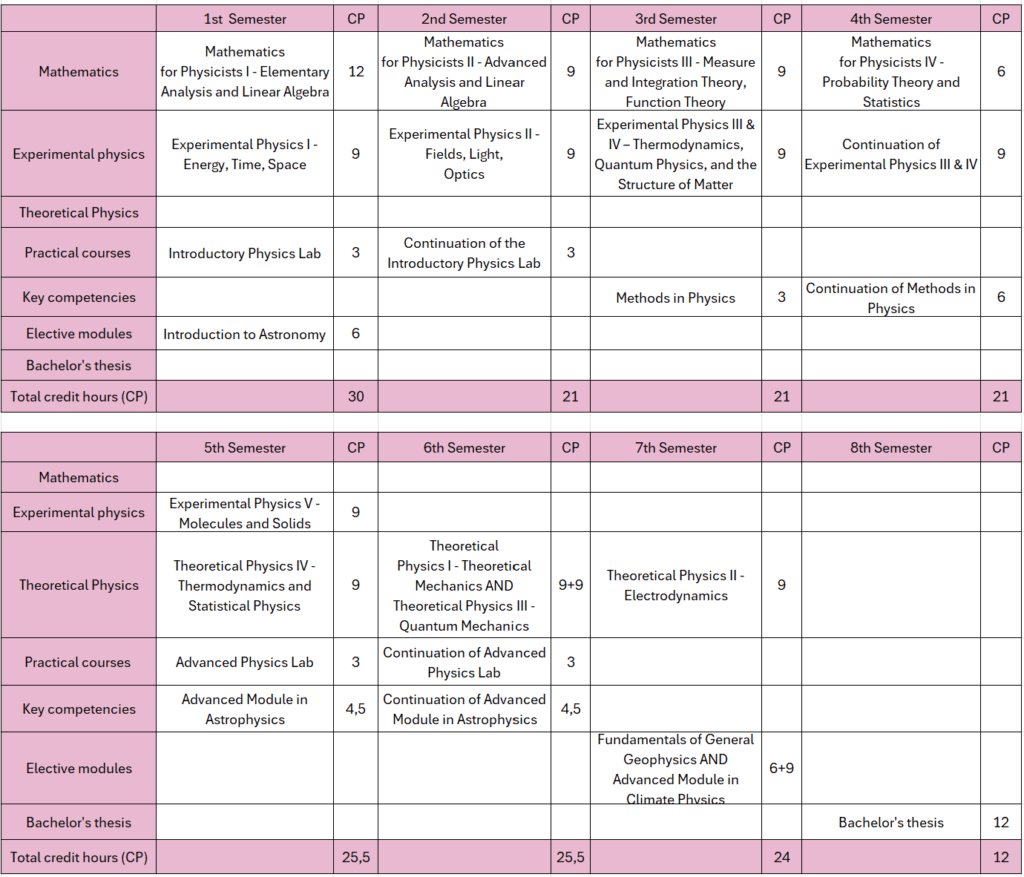
As shown in the plan, I completed the modules in mathematics and experimental physics in the first four and five semesters, respectively, following the intended structure. Together with the other modules, this brought me to 30 credit points in the first semester. However, it became clear that this workload is high and that it is very difficult to engage intensively with the course content while simultaneously maintaining a weekly work schedule of about 40 hours.
For this reason, I adjusted my study plan and began Theoretical Physics in the fifth semester instead of the second. Since these modules build on each other only minimally, I was flexible in the order and could adapt them accordingly. This also allowed me to take individual modules concurrently.
I completed the lab courses as planned: the introductory lab in the first year, Methods in Physics in the second, and the advanced lab in the third year. This ensured a logically consistent progression in the development of my practical skills.
Most of the elective modules were moved to later semesters. In terms of content, I focused on topics in astrophysics, climatology, and geophysics, following my own interests. By taking block courses—that is, intensive courses during the break between semesters—I was able to complete more modules per semester without further increasing my workload during the lecture period.
I set aside an entire semester for my bachelor’s thesis. Without any major concurrent commitments, I was able to focus entirely on the thesis and completed it within three months.
Overall, these adjustments allowed me to reduce my average course load to under 30 credit points per semester. While this extended my bachelor’s program by just under a year, I found the course of study to be significantly more balanced. Furthermore, this keeps me within the typical range of the average program duration of seven to eight semesters.
Note: Further information about the single-major Bachelor’s program in Physics in Potsdam is available on the university’s official website. There you will find an overview of the program’s structure and curriculum, as well as information on the application and enrollment procedures and academic advising.
6 Conclusion – Why Studying Physics Is Worth It
The Bachelor’s program in Physics is a challenging yet extremely versatile course of study. It not only provides a deep understanding of fundamental laws of nature but, above all, cultivates analytical thinking. The ability to structure, model, and quantitatively describe complex systems is a core competency that extends far beyond the field of physics.
The methodological training is very broad. Through the close integration of mathematical approaches, theoretical concepts, and experimental practice, graduates are able to systematically solve challenging problems on their own. This flexibility opens up many different career prospects—both within physics and in related fields such as IT, data analysis, engineering, or business-related activities.
At the same time, the program offers ample freedom to pursue one’s own interests in physics and to delve deeper into them in a targeted manner. Through required-elective modules, advanced modules, and within the framework of internships and the bachelor’s thesis, students can set their own academic priorities. As a result, the program is not merely a general foundational education but also enables initial specialization in areas that are particularly motivating on a personal level.
Looking back, my physics degree has provided me with comprehensive professional and personal growth. Over the course of my studies, I have acquired a broad foundation of physics knowledge as well as numerous methodological skills, the scope and depth of which I was not fully aware of at the beginning. Also my perseverance, frustration tolerance, and ability to work in a team were constantly challenged and have developed significantly over time.
Over time, my way of thinking has changed significantly. Today, I approach problems in a more structured and analytical way, and I have learned to explore new topics on my own, understand technical literature, and plan and implement my own projects.
I also found the collaboration with other students, as well as with academic staff and researchers, to be very positive. The interaction during internships, exercises, or study groups was not only academically helpful but also demonstrated just how open and supportive the academic environment can be. In particular, I found the opportunity to get help whenever I had questions and to gain insights into current research to be very motivating.
My conclusion: Studying physics requires dedication and perseverance, but in return it opens the door to all kinds of physics-related questions and a deeper understanding of the world that I could not have imagined before starting my studies.
Sources and further information
- Uni Potsdam: Ein-Fach-Bachelor Physik, accessed on March 29, 2026
- Uni Jena: Bachelor Science Physik, accessed on March 29, 2026
- TU Berlin: Bachelor Science Physik, accessed on March 29, 2026
- DPG: Auf dem Weg zum Physikstudium, accessed on March 29, 2026
- DPG: Studium und Beruf, accessed on March 29, 2026
- Studienatlas Physik: Willkommen beim Studienatlas Physik, accessed on March 29, 2026
- Uni Leipzig: International Physics Studies Program (Honours) B. Sc., accessed on March 29, 2026
Anyone interested in my personal experiences during my bachelor’s studies can find blog posts about my daily student life here:
- Live or study? – The highs and lows of my first exam phase (2022)
- University life – 2nd attempt, or: Trying to survive
- Semester 3 & 4 – Being on the same (Compton) Wavelength
- The normal madness and the joys of cycling – semesters 5 & 6
- Quantum, cows and paleoclimate – An update on my 7th semester
- Four years of bachelor’s studies – a dignified end?